


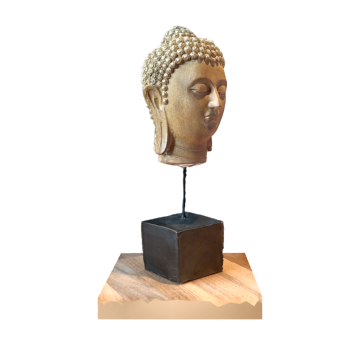
Buddha head ornaments
This is a Buddha's head ornament, commonly used in home decoration, designed to create a peaceful, Zen atmosphere. The sculpture depicts the head of Shakyamuni Buddha. It is characterized by slightly drooping eyes, a calm expression, elongated earlobes (symbolizing the abandonment of worldly wealth) and a spiral bun on the top of the head. It is installed on a simple black base with a natural wood grain square bottom under the base. The overall design combines classical Buddhist elements and modern minimalist style.

Buddha Head Statue of Sakyamuni, Founder of Buddhism
The statue depicts the head of Buddha Sakyamuni, the founder of Buddhism, with a meditative look, closed eyes, a bun on the top of the head (called "Ushnisha", symbolizing wisdom) and a spiral bun (called "snail hair").

Stone carving of Buddha's head (Thai dra mantle period)
This is an ancient stone Buddha head with a unique artistic style, and is usually identified as a work originating from the Dhara Mantdi (Mon-Dvaravati) period in Thailand, about the 7th to 8th centuries AD. It combines Indian archetypes and local aesthetics, and is an important representative of early Thai Buddhist art. The Buddha's head shows a serene, introspective look. The piece is carved from sand or limestone. As an ancient relic, it bears obvious traces of years and beautiful patina (patina), reflecting its long history.
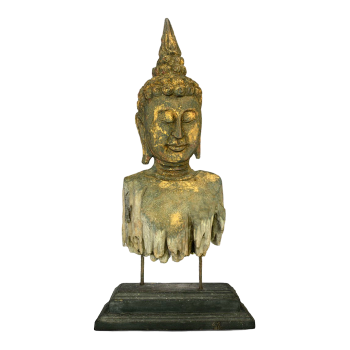
Thai cultural heritage gilded Buddha head wood carving
The highlight of this work of art is that it combines the charm of hand carving with traditional craftsmanship. The making of Buddha statues in Thailand is an expression of religious belief and a manifestation of cultural history.

Shakyamuni Buddha statue (8th century AD)
The limestone Buddha head of Shakyamuni, dating back to the 8th century AD, is currently housed in the Minneapolis Academy of Arts. The Buddha statue of Shakyamuni is highly compatible with the classical style developed by early sculptors of the Tuora bowl. The face is square, the mouth is wide, the nose is flat, and the hair is curly. Although the artist of the Tara bowl drew inspiration from the idealized sculpture concepts of India, this portrait indicates that the facial features of the local residents quickly integrated into their religious art.

Buddha Head Statue
This Buddha head is a work from the 2nd to 3rd century AD, originating from the ancient Indian state of Dhara (now Pakistan), made of gray gneiss, with dimensions of 27.8 × 16.4 × 19.6 centimeters. It is currently preserved at the Art Institute of Chicago.
![[3D Scanning] Copper Buddha Head Half-body Buddha Statues AR Buddha Crafts Copper Products Ornaments](https://file.freecreat.com/user/13/13/2023/0926/115136ZuXfUUgs.png?x-oss-process=image/resize,m_pad,w_350/quality,q_80)
[3D Scanning] Copper Buddha Head Half-body Buddha Statues AR Buddha Crafts Copper Products Ornaments
The Buddha bust is made of cast resin, rich in bronze powder, and has the charming appearance of a vintage work.

Popular Models
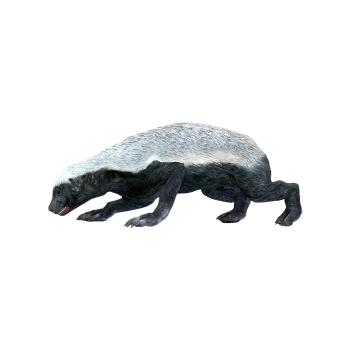
Honey Badger (3D animated model)
192 View
Guinea fowl (3D animated model)
163 View
Wild Goose (3D animated model)
185 View
Red Fox (3D animated model)
153 View
Random Model
Dakotaraptor (3D animated model)
172 View


German HAGEN large cruiser
661 View

18th Century Chinese Cloisonne Vase
962 View


Small story style ceramic disc
905 View

Pigeon 3D model animation
1224 View